Geometrical Optics vs Transcendence
Guy Velnick on Carboncopies
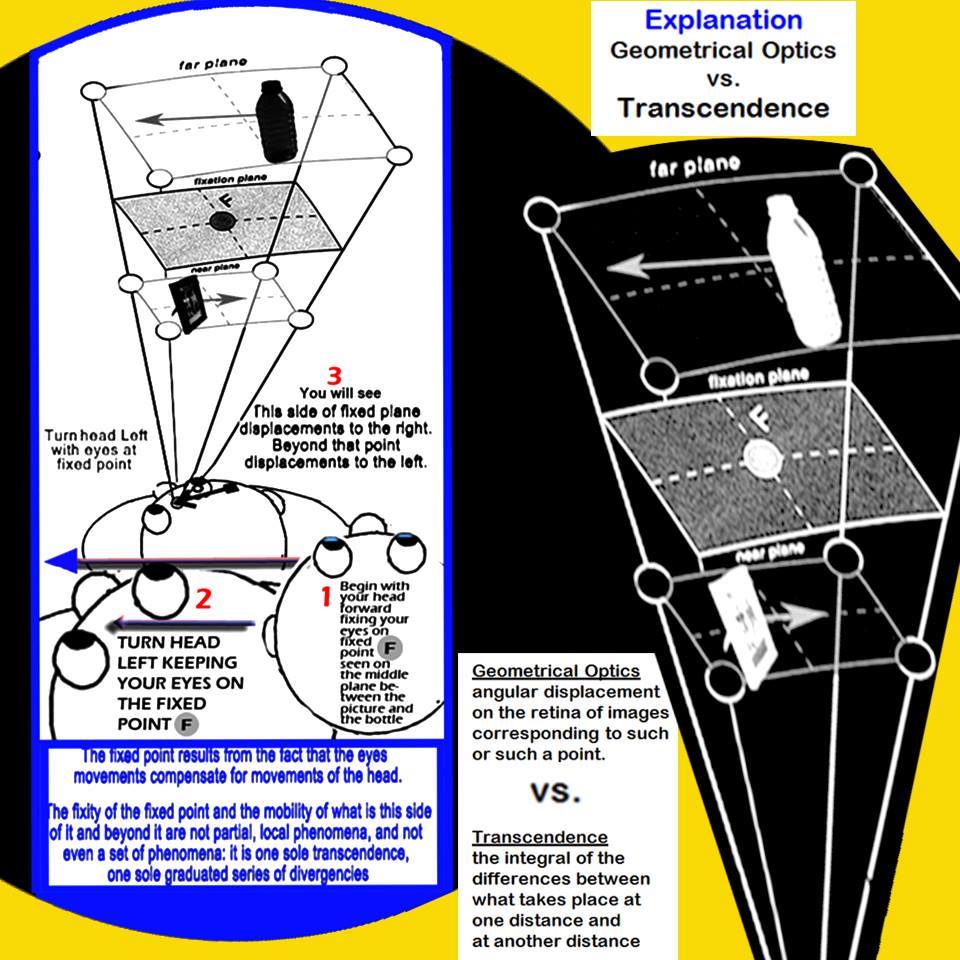
This experiment is evidence that consciousness is not a simple matter of brain function even though a brain is necessary for consciousness it does not equal it nor is it simply an emergent property of it. There is a very fine point here which is difficult to express, but I will make the effort in what follows: When I move myself, the perceived things have an apparent displacement that is inversely proportional to their distance — the closest move more ------ The extent of the displacement can serve as an index for the distance. Fundamental: it is absolutely artificial to recompose the phenomenon as geometrical optics does, to construct it on the basis of the angular displacement on the retina of images corresponding to such or such a point. I am ignorant of this geometry, and what is given to me phenomenally is not a set of displacements or non-displacements of this kind, it is the difference between what takes place at one distance and at another distance, it is the integral of those differences; the "points” that the optico-geometric analysis gives itself are, phenomenally, not points, but very small structures, transcendencies. Even to describe these as “alterations” or “non-alterations” is already to substitute the original differentiations, “projections” on a space for objective analysis. To tell the truth, movements, rests, distances, apparent sizes, etc., are only different indexes of refraction of the transparent medium that separates me from the things themselves, different expressions of that coherent distention across which Being shows itself and conceals itself.
Now consider the example in the diagram. One’s eyes say are 9 feet from the point of fixity noted to be on the central plain between two objects each 3 feet away from it with one being the far side of it and the other closer to me by three feet than the fixed point. Keeping my eyes on the fixed point I turn my heard I note the apparent displacement of the objects which appear to move around it as if my head were turning AT THE POINT OF FIXITY. If the geometric optics were the source of the apparent displacements then the objects would both move left or right. They would not appear to move in opposite directions. One would move quicker and the other slower, but there is no way to explain them moving in opposite directions by optics or the position of the image on the retina. What happens is the pivot of my neck centers itself at the point of fixation between the objects; one this and the other that, side of the point I am holding fixed. The objects pivot around the point of fixity just as my head is turning on my neck. The further object shifts in the direction my head turns, and the closer one moves in the opposite direction. It is as if my head by maintaining the gaze of my eyes on the point of fixity as it turns, establishes itself as movement at a distant point, it is as if my neck and the fixed point held by my gaze at the point between the two objects are established at the common center however it is projected to where the fixed point is...
Nowhere is there established in the physicality of brain functioning the consciousness by means of which up-loaders of brain substrates would like to establish consciousness preserved...!!!
Discussion
Justas Liberty I read the text and looked at the diagram twice but still have no idea what they're saying about how about visual parallax relates to consciousness, or to WBE
Guy Velnick OK One has to try the experimental effort in order to know what I am talking about Place three objects at varying distances from yoiu. Say one 6 feet one 9 feet and one 12 feet from you. make sure they are in the same field of vision and more or less in a row moving away from you. With your eyes fixed on the middle one turn your head to the left making sure to keep your eyes focused on the fixed plane of the center object. You will notice that the object closest to you and the object furthest rotate around the center one, whereas if the apparent motion was really due to the optical displacement of light on the retina they would move in the same directions... it seems to me. So maybe we can discuss this cuz I am not saying this is proof but it is still a good starting point to discuss correspondence theory... Also the results may or may not have a bearing on your project... but it is at least a good starting point... thanks
RE Justas Liberty I get the same result - two objects rotating around the center one - with a phone camera. I still don't understand what's special about that or how that relates to consciousness, which presumably a phone camera does not have.
RE Stuart Gray You mean ‘Parallax’?
Marinko Rudić Vranić In robotics this problem (relative movement of different objects in space) is solved using mathematical tools. Robots constantly calculate and recalculate their relative position in space, similar calculations are done by GPS devices and smartphones. All these mentioned devices "know" their relative positions in space compared to other objects, but still are not conscious.
Randal Koene Also not sure how this relates to WBE. And, doubly not sure how this is supposed to prove consciousness being not a matter of brain function. For this and any other mental imagery and other impressions created by our modeling of the world, it baffles me if the first instinct is to say "consciousness is not created by brain functions" instead of saying "well, there is clearly some interesting stuff going on in the way the brain is processing information here". Seems like a leap. Hmm.
Gregory Norris I don’t believe we understand enough about how the brain works, or evolved to function in our environment to make the assumption of partial duality. In this case, consciousness may be an emergent property, or it may be a matter of perspective. I think your observation is a stretch; however some of the greatest minds in physics used forms of optical geometry to conduct thought experiments. I recommend reading The Holographic Universe and The Fractal Geometry of Nature if using an optical approach to attempting to understand human consciousness.
James Vaughn Our brains devote a huge volume to processing vision. Heck, you couldn't aim with both eyes open if it didn't. So when all the processing tricks are uploaded will you be stuck with the programming that creates optical illusions?
RE Gregory Norris I would hope so, it might be a good test for determining the accuracy of emulating the occipital lobe.
Guy Velnick Well on second thought I guess I was starting small simply indicating that even at the level of perceptual consciousness it is not the "brain state" that sees... but now I recognize the error of my ways. You folks project beyond that and are talking about going directly to full on mind consciousness by way of brain emulation... I see now, how silly of me... Just to set the parameters we know so far that what brains do is conduct I think we can accept that premise, right? Are we to assume that it is also the brain that thinks, that remembers, and that interprets... none of which we actually have any evidence of right? So far we DO know brains conduct. What I had intended on noting in the OP is that even at the level of perception the correspondence theory had been ruled out decades ago. But we are going to simply skip perceptual consciousness and go directly to what? Transcendental Mediation? How are we going to know whether the mind we have emulated as 'substrate independent' is the mind we think it is? It is going to look like any ol' mind you know a thick pool of chunky juice and really have no way to express itself. So in the what scenario is this being envisioned? With Body or Without Body, becasue without body does seem to present certain obstacles such as feedback to measure our results. I am just trying to get a handle on this WBE and also SIM. I definitely have some catching up to do. Sorry, I do not mean to doubt, I am just kind of trying to process all of this... and I operate on quite a different working model... but it is not necessarily more valid than any other...